Journal
Samodivas: The Wild Forest Spirits of Balkan Folklore
Who are the samodivas? Meet the wild forest spirits of Bulgarian and Balkan folklore - their midnight dances, stolen cloaks, healing herbs and the legends still told today.
Somewhere in the Bulgarian mountains there is a meadow where the grass grows in a perfect circle – darker, thicker, greener than the rest. Old people will tell you not to step inside it. That is where the samodivas danced last night.
Who are the samodivas?
Samodivas (Bulgarian: самодиви, singular samodiva) are female spirits of the wild in Bulgarian and wider Balkan folklore. In western Bulgaria and North Macedonia they are also called samovili; their closest relatives are the vila of Serbian and Croatian legend and the rusalka of Eastern Slavic tales.
The name is usually read as sam (“alone”) + diva (“wild”): the ones who are wild by themselves, who belong to no house and no man. Some also hear in it the old Slavic div – something between wild and divine. Both readings fit.
They are neither good nor evil. They are the forest, the spring and the mountain in human form – beautiful, free, and not interested in human rules.
What does a samodiva look like?
Folk songs paint them almost the same way across the whole region:
- Young and impossibly beautiful, with long loose hair – often golden – falling to the ground.
- Dressed in white: thin shirts, veils and, most importantly, a cloak or set of “samodiva clothes” that holds their power. In some songs they have wings.
- Riding wild deer, using snakes as reins and whips.
- Never quite human – in some villages it was said that under the long dress a samodiva hides the feet of a goat or a donkey.
Where do they live?
Far from villages: high mountain meadows, deep forests, caves, old trees and, above all, springs and wells. Across Bulgaria you can still find springs, meadows and peaks with names like “Samodiva’s well” or “Samodiva’s meadow”. Pirin, Rila, the Rhodopes and Strandzha are full of such stories.
The water from a samodiva’s spring could heal – or harm. It depended on whether you asked permission.
The dance no one returns from
The best-known samodiva legend is about their dance – the samodivsko horo.
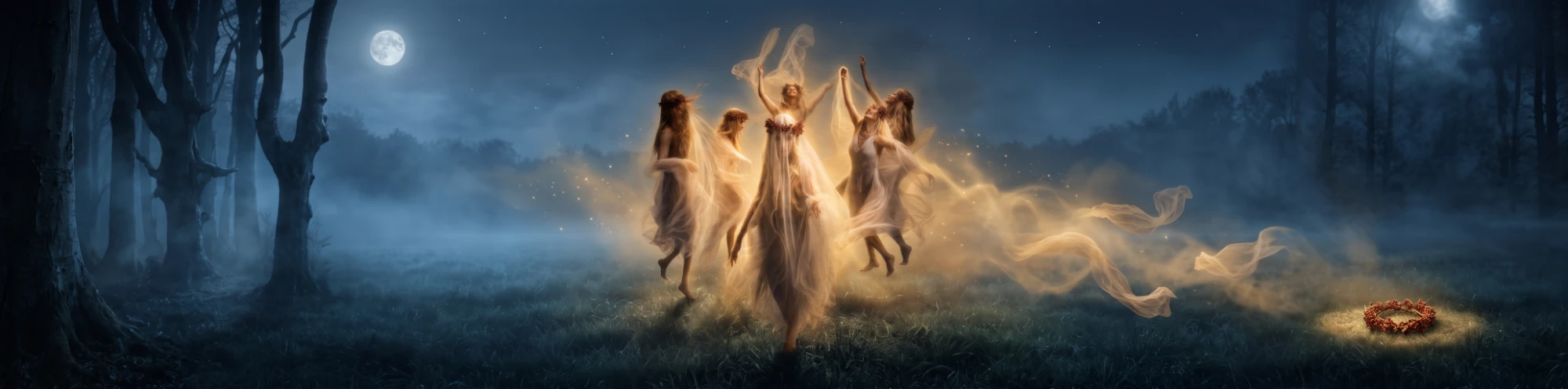
On moonlit nights, from midnight until the first rooster crows, samodivas gather in the meadows and dance in a closed circle. The grass under their feet grows back darker and in a ring, which is how people knew where they had been.
A traveller who sees the dance cannot look away. One who joins it is danced until he drops – and either dies, loses his mind, or is taken away forever. Shepherds were warned not to play their pipes too beautifully in the mountains: a samodiva might hear it and want the piper for herself.
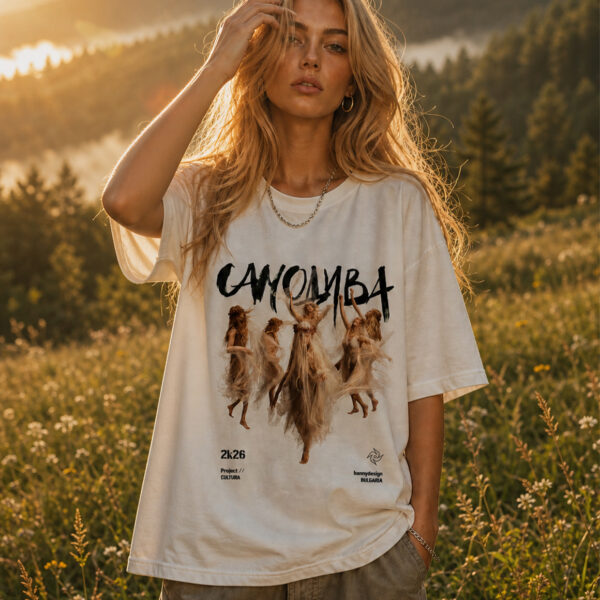
This is the moment our Samodiva tee is built around: seven figures in airy veils, caught between dancing and vanishing.
The stolen cloak: how to marry a samodiva
The other great samodiva story is a love story – and a warning.
A young man (often called Stoyan in the songs) finds samodivas bathing in a mountain lake. Their clothes lie on the shore. He hides one cloak. When the others fly away, one samodiva is left behind, powerless, and has to follow him home and become his wife.
She lives with him for years and bears his children. But the cloak is still hidden somewhere in the house. One day – usually at a wedding or a feast, when she is asked to dance – she persuades someone to give it back “just for one dance”. She puts it on, rises above the horo, and is gone. Some songs say she returns at night to feed her child. Most say she never returns at all.
The lesson is old and simple:
You cannot own something wild. You can only borrow it.
Healers, sisters and protectors of heroes
Samodivas are not only dangerous. They know every herb in the mountains, and many folk healers were said to have learned their craft from them – or to have been “taken” by them for a while and returned with the gift of healing.
In epic songs they are also the blood-sisters of heroes. The great Balkan hero Krali Marko has a samodiva as his sworn sister who warns and helps him, and some songs say he got his enormous strength from drinking samodiva milk as a child.
Rusalia week: when the samodivas are strongest
In the Bulgarian folk calendar the week after Pentecost – Rusalska nedelya, Rusalia week – belonged to the samodivas (also called rusalii in this context). People avoided working in the fields, sleeping outside or bathing in rivers. Anyone who fell ill that week was believed to have been “touched” by them.
In north-western Bulgaria groups of men called kalushari or rusaltsi performed a ritual healing dance with sticks and herbs, dancing until they fell into a trance to cure those the samodivas had struck. A close relative of this ritual, the Romanian Căluș, is listed by UNESCO as Intangible Cultural Heritage.
Why samodivas still matter
Samodivas are one of the few European myths where the feminine is neither a saint nor a victim. They are free, dangerous, generous, unpredictable – and they don’t need anyone’s permission. That is probably why they never left Bulgarian songs, names of places, children’s tales and today’s art.
That is also why they were the first design in our PROJECT // CULTURE collection: old Balkan myths brought out of the stories and into everyday wear.
Wear the myth
Our Samodiva T-Shirt pairs hand-lettered Cyrillic “САМОДИВА” with seven dancing samodivas – the dance no one returns from. Printed on demand near you and shipped worldwide.
Next in the collection: Lamya, the dragon-like guardian of the waters.
FAQ
What is a samodiva?
A samodiva is a female forest spirit from Bulgarian and Balkan folklore – beautiful, free and dangerous – who lives in the mountains, guards springs and herbs, and dances at night in the meadows.
Is a samodiva the same as a vila or a rusalka?
They are close relatives. Samovila is another Bulgarian name for the same being; the Serbian and Croatian vila is very similar; the Eastern Slavic rusalka is more tied to water and to the dead.
Are samodivas good or evil?
Neither. They can heal, help heroes and reward respect, but they punish anyone who disturbs their dance, their springs or their freedom.
How do you pronounce samodiva?
SAH-mo-dee-vah, with the stress on the first syllable.
Wear the myth