
Journal
Lamya: The Three-Headed Dragon of Bulgarian Folklore
Meet the lamya, the many-headed she-dragon of Bulgarian folklore who hoards gold, locks up the springs and steals the golden apple.
Every culture has its dragon. Bulgaria has two, and they are not on the same side.
One is the zmey, a fiery winged serpent that guards the village fields. The other is the lamya (ламя, pronounced LAH-mya): a scaled, many-headed she-dragon who lives in the dark places of the world and takes what isn’t hers. For centuries she was the monster Bulgarian children heard about at bedtime, and the reason their grandparents looked at the sky before a hailstorm.
What is a lamya?
In Bulgarian folk belief, the lamya is a giant reptile with yellow scales, webbed wings, sharp claws and teeth, and one or more dog-like heads on long serpent necks – most often three or nine. She lives at the bottom of lakes and seas or in deserted forests, and in her lair she piles up gold, silver and precious stones.
Her real power, though, is over water. The old beliefs say she can stop the waters of wells, rivers and lakes. When the lamya holds the springs, the fields dry out, the animals go thirsty and the people have to pay her price – a human life, given to her to devour. In the tales, that price is usually the most precious thing a town has: a girl, chosen by lot, sent to the spring.
Lamya vs. zmey: the storm in the sky
Western dragons are mostly villains. Bulgarian dragons are more complicated.
The zmey is male, fiery and often a protector: in many villages people believed he guarded their land and its harvest. The lamya and her sister-monster, the hala, are his enemies. When they meet in the sky, the battle is the storm itself – thunder, lightning, hail and torrential rain. So when hail beat down the wheat, it meant the lamya had come for the harvest, and somewhere above the clouds a zmey was fighting her off.
The tale of the three brothers and the golden apple
The most loved Bulgarian fairy tale with a lamya in it goes like this.
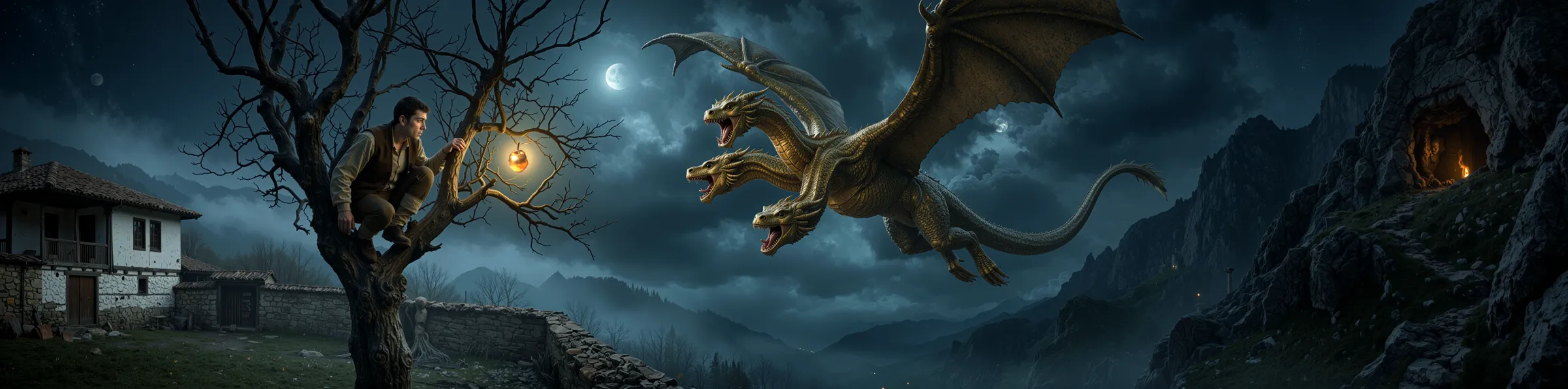
An old couple has three sons and one apple tree in the yard. Every year the tree gives a single fruit – a golden apple – and every year, on the night it ripens, something flies down and steals it. The eldest brother guards the tree and falls asleep. The middle brother guards it and falls asleep too. The youngest climbs into the branches with a pocket of walnuts, cracking one whenever his eyes close. At midnight the lamya comes. He strikes her with his knife, and she flees, bleeding, with the apple.
The brothers follow the trail of blood to a deep hole in the mountain. The two older ones are lowered on a rope and lose their nerve. Only the youngest goes all the way down – into the lower world, where he finds a palace, three captive maidens and the lamya herself. He kills her and sends the maidens up the rope. But his brothers, jealous, leave him below.
In the lower world he finds a kingdom without water. A monster – a lamya in some versions, a hala in others – sits on the spring and demands a girl every year, and this year it is the princess. The youngest brother kills the monster and the water flows again. All he asks in return is a way home. On his way he comes across a nest of eaglets in danger and saves them from a snake. Their mother, the great eagle, repays him: she will carry him up to the world of light, and all she asks is that whenever she grows hungry on the way, he gives her a piece of meat. The journey is long, and the meat runs out before the light is in sight – so he cuts a piece from his own body and feeds her with it. Back home he unmasks his brothers, marries the girl he rescued, and the golden apples stay with their family for good.
It is a story about patience, courage and kindness – and about a dragon who learns that the quiet youngest son is the one you should have watched.
St George and the three-headed lamya
Christianity gave the lamya a new enemy: St George, the dragon-slayer on the white horse. In church icons the dragon under his spear is usually a single-headed beast, as on this 1838 icon by the Bulgarian master Zahari Zograf, now in the Burgas Art Gallery – with the princess waiting in the tower to be given to the monster.
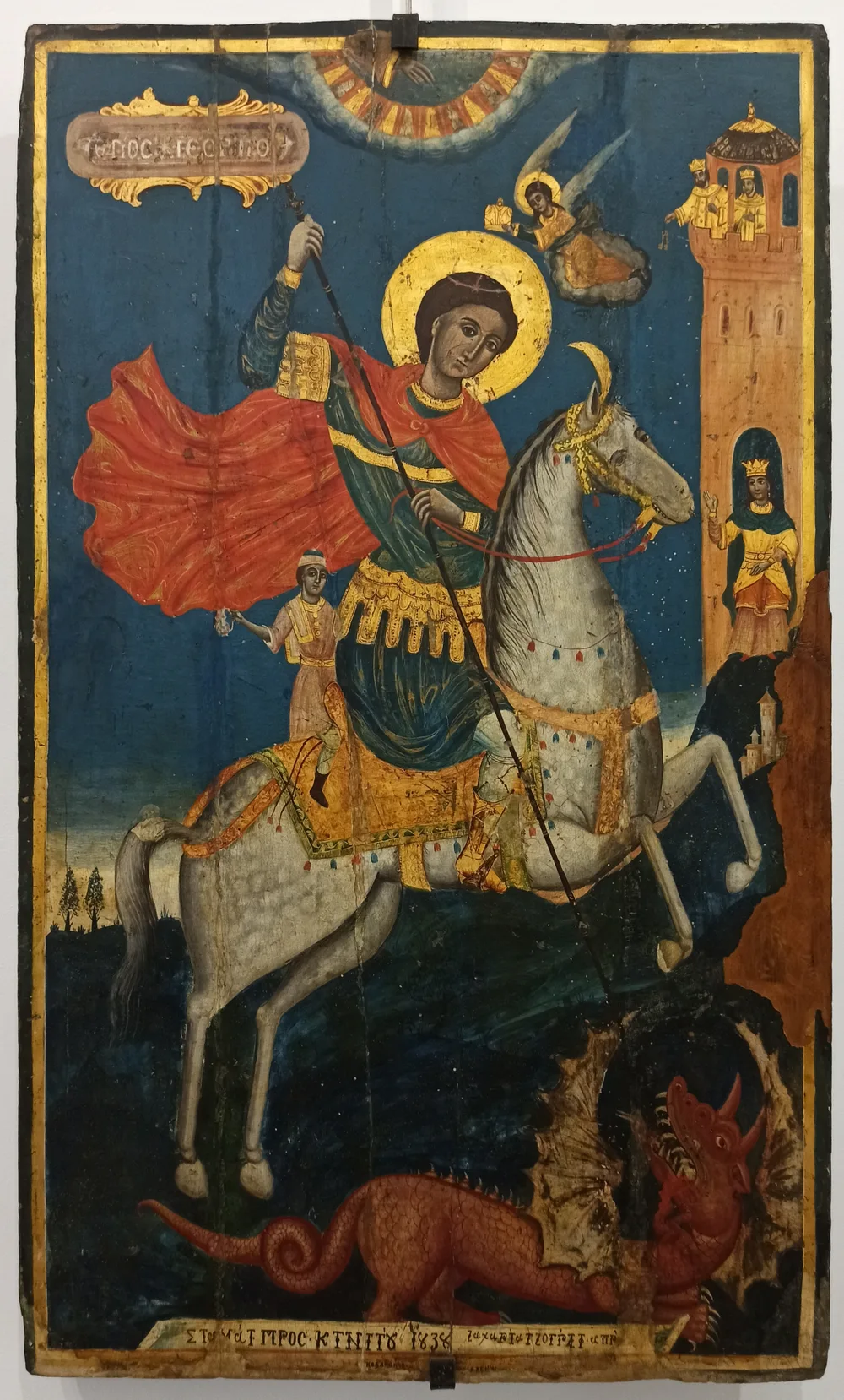
But Bulgarian folk songs tell it their own way. There, St George kills a three-headed lamya, and from her body flow three rivers: one of milk, one of wine and one of wheat. The monster that locked up the water becomes the source of everything a village needs to live.
Why the lamya still matters
The lamya is what our ancestors were afraid of: drought, hail, a lost harvest, a stolen future. Every tale about her ends the same way – the water flows again, and someone ordinary turns out to be braver than anyone expected.
That is why we put her on a tee. The Lamya T-shirt shows a golden three-headed lamya holding the golden apple, framed by wheat, grapes and Bulgarian embroidery – the harvest she threatens and the rivers of wheat and wine that flow when she is defeated. Above her, “ЛАМЯ” in blackletter Cyrillic.

Wear the myth. Tell the story.
More from Bulgarian folklore: Samodivas, the forest spirits who dance until dawn and Narichane, the ritual of word magic.
Sources
- Hristo Vakarelski, Ethnography of Bulgaria (Sofia, 1977), pp. 429–430
- Anani Stoynev (ed.), Bulgarian Mythology: Encyclopedic Dictionary (Sofia, 1994), p. 202
- Dimitar Marinov, Selected Works, Vol. I: Folk Belief and Religious Folk Customs (Sofia, 1981), pp. 302–304
- “The Three Brothers and the Golden Apple”, Bulgarian folk tale (retold in our own words)
- Icon: Zahari Zograf, St George, 1838, Burgas Art Gallery (photo: Spiritia, Wikimedia Commons, CC0)
Wear the myth