Journal
Narichane: The Ancient Bulgarian Ritual of Word Magic
What is narichane? The Bulgarian folk magic ritual of speaking wishes into water, bread and people – its roots, how it is done and how it always ends.
In Bulgaria, words were never just words. A grandmother leaning over a newborn, a host lifting the bread at the Christmas table, a girl whispering over a copper of water at midsummer – all of them were doing the same thing. They were planting a wish and expecting it to grow. This is narichane (наричане, pronounced nah-ree-CHAH-neh).
What is narichane?
Narichane is the old Bulgarian practice of speaking a wish out loud – into water, into food, into an object or straight to a person – with the belief that the spoken word has the power to make it real. It is Bulgarian folk magic in its simplest form: no tools you can’t find in any kitchen, no special words you have to buy. Just intention, voice and a clear heart.
The verb naricham means “to name”, but also “to destine”. The same root lives in narechnitsi, another name for the orisnitsi – the three fate-spinners who, in Bulgarian legend, visit a child on its third night and speak its destiny. Naming something and deciding its fate were, for our ancestors, very close.
Narichane on the 40th day
In Bulgaria, the biggest narichane of a child’s life – also called orisvane – is done on the 40th day after birth.
Guests bring sweet foods to the mother and baby – for a sweet life. A round loaf, the pitka, must be kneaded for the day. It is held above the heads of the mother and baby: a symbol of the bond between the newcomer, the powers above and the roots below.
Two women – unmarried, if possible – spread a white cloth over the heads of mother and child. They matter most: they are the baby’s main orisnitsi, its fate-speakers. Over the cloth they break the first three pieces of the pitka:
- The first is spoken for the Holy Mother of God.
- The second is spoken for the baby.
- The third is spoken for the mother, who eats it straight away to take on the strength of motherhood.
Then the cloth, with the piece left in it and the crumbs, is tied – not too tight, so the child won’t grow up tight-fisted, and not too loose, so it won’t grow up careless. It is placed somewhere high – in most Christian homes, up where the icon of the Holy Mother hangs – so the child will reach great heights and great success.
Finally, everyone breaks off a piece of the pitka, speaks a wish for the child and eats it – always with honey.
Where does narichane come from?
Narichane is older than any calendar. It grew from pre-Christian beliefs about the power of the word and later lived side by side with Christian holidays, so today you find it woven into both. Grandmothers did it over cradles, the host did it at the holiday table, village healers did it for the sick – and anyone could do it for someone they loved.
When do Bulgarians do narichane?
Narichane needs no special day – anyone can do it, anytime. But some moments in the year carry it more strongly:
- Christmas Eve – the host lifts the round ritual bread and speaks wishes for health, a rich harvest and a full home before it is broken and shared.
- New Year’s Day – children tap people on the back with a decorated cornel branch, the survachka, and chant wishes for a healthy, fruitful year. The koledari, the Christmas carollers, do the same for a fertile year, with the kolache ring breads the hosts give them threaded onto their staffs, the gegi.
- Enyovden (24 June) – girls drop rings into a pot of “silent water”, carried home without a single word spoken, and the songs sung over it foretell who they will marry.
- Vodici (5–7 January) – the great feast of water. On the night before 6 January, it is said, the sky opens and every wish spoken in that hour is heard. Water drawn from a spring in silence – silent water – is at its strongest. In the morning a cross is thrown into the river and men dance a horo in the icy water: the colder it is, the healthier the year.
- The milestones of a life – a birth, a child’s first steps, a girl’s seventh year, a boy coming of age, a wedding, a new home, a death.
And often, when the words are spoken, a red woollen thread is tied around the wrist, so the wish stays with the person wherever they go.
How is it done?
- Know that your words are magic. Narichane only works if you mean it and truly believe it. That is why faith matters.
- Speak your wish into something or someone. An object, to guard and protect you. A person – health, love, or whatever your pure heart wishes them. Water and bread are the oldest carriers.
- Always close it the same way: “May my spoken word be done.” Some grandmothers keep it even shorter: “Da bude” – “So be it.”
The ending matters. It seals the wish, the way you close a letter before you send it.
Zdravets: passing the wish on
Narichane needs nothing but your voice – but there is one old helper you can add. Speak your wish into a bowl of water, then dip a bunch of zdravets (Geranium macrorrhizum, known in English as bigroot or Bulgarian geranium) into it and sprinkle the people around you with the wet leaves. Wherever the water lands, the wish travels with it. It is usually a wish for health – fitting for a plant whose Bulgarian name comes from zdrave, “health”. One bowl, one bunch, and a whole room is blessed at once. You can sprinkle your home the same way, to bless it. In fact, Christian blessing with holy water works on the same principle: the holy words are locked into the water, which remembers them and passes them on to the bodies it touches. The zdravets is optional, though – if you don’t have it, water and your words are all you need.
Why it still matters
We say “good luck” a dozen times a day without thinking. Narichane asks for the opposite: one wish, said slowly, meant completely. Maybe that is why it has survived – it reminds us that what we say to each other, and the way we say it, shapes what comes to us.
Our Narichane poster
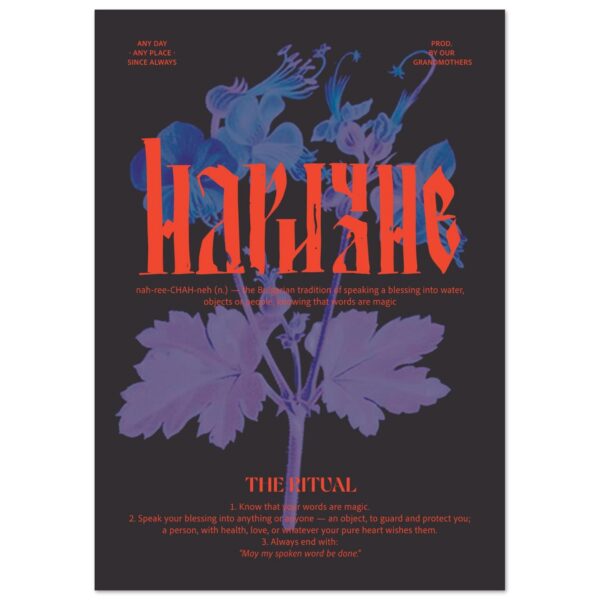
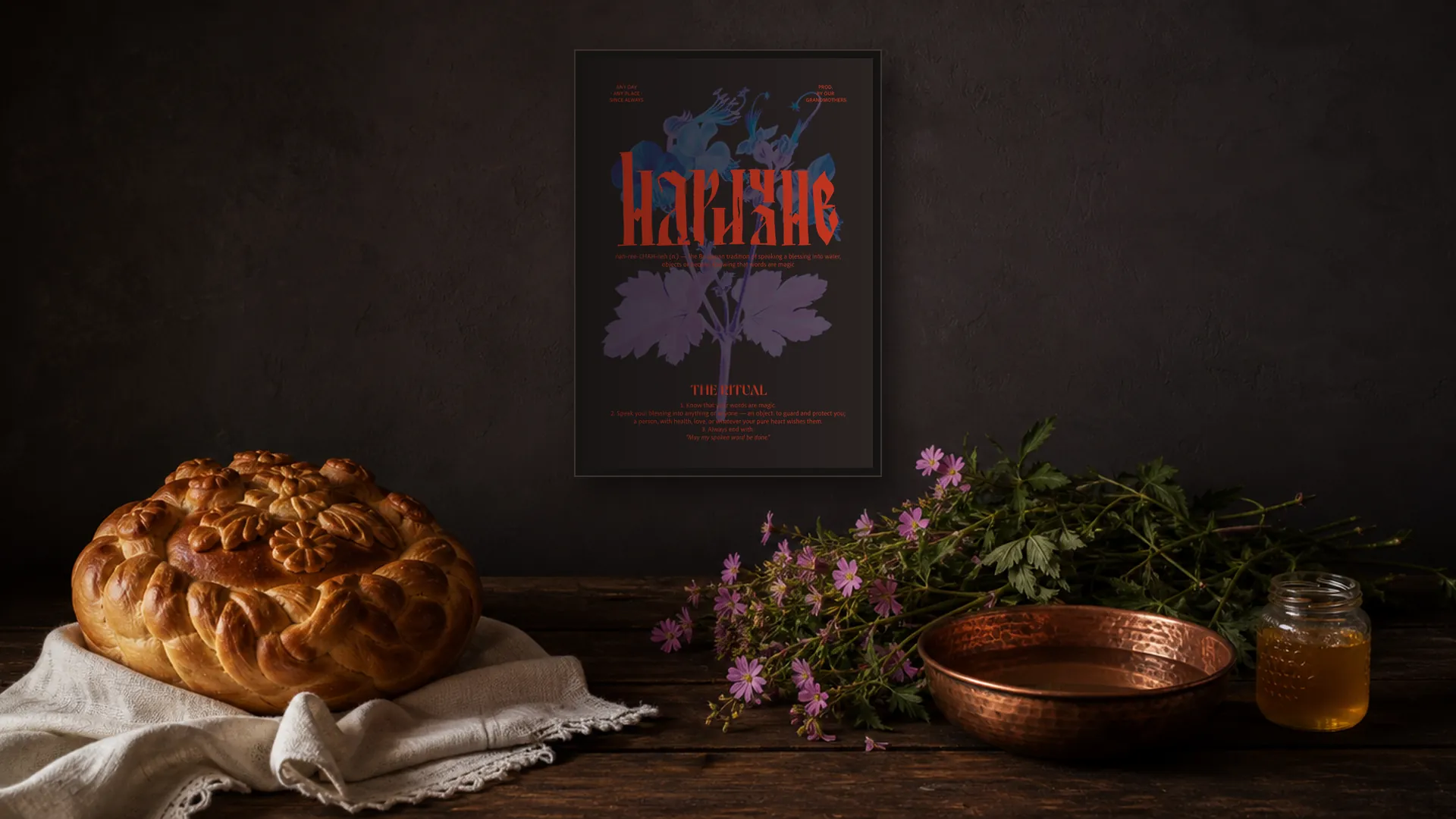
We turned the ritual into a poster: the word наричане hand-lettered in Slavic-style calligraphy, over a vintage engraving of zdravets – the plant whose Bulgarian name comes from the word for health – with how the ritual is done printed below. A little magic for your wall.
More Balkan folklore: Samodivas: The Wild Forest Spirits of Balkan Folklore
Bring the myth home